
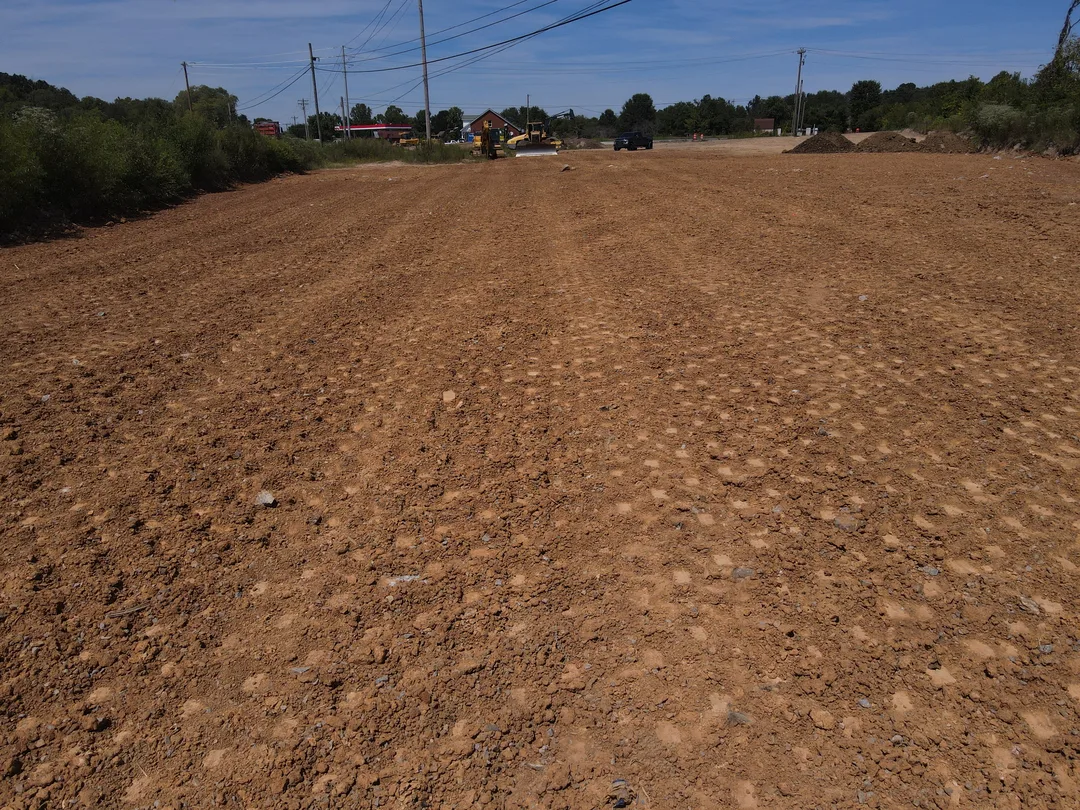
What does yard grading and drainage work cost in 2026?
The 2026 pricing guides are consistent: small regrades run $500 to $1,000, a full backyard regrade runs $1,000 to $5,000, and the average whole project lands a little over $2,000. Per square foot, finish grading runs about $0.40 to $1 and rough grading about $1 to $2. Around Franklin and Williamson County, those national ranges hold up well, and this guide explains where inside them your yard is likely to fall.
If you would rather skip straight to a number, our grading walk-throughs are free and the quote comes back written.
Why yards here hold water in the first place
Middle Tennessee sits on clay, and clay sheds water instead of drinking it. That makes grade the whole game: whatever direction the surface falls is where the water goes, and a couple of inches of wrong fall can manufacture a permanent swamp. New-construction yards make it worse, because builders compact the lot hard and finish with a thin scattering of topsoil, which is why so many calls we get come from subdivisions a few years old in Spring Hill, Nolensville and La Vergne.
The fix is machine work: reshape the surface so the fall carries water off the property, cut a swale where a path needs to be created, and rebuild the surface with real topsoil so the repaired yard grows grass. Products, additives and gutter gadgets do not change where the ground points.
What the money buys at each price level
| Project | Typical 2026 cost | What is happening |
|---|---|---|
| Small regrade | $500 – $1,000 | One problem area, a low corner, one foundation wall |
| Foundation grade fix | $500 – $3,000 | Fall reset away from the house, downspouts tied out |
| Full yard regrade | $1,000 – $5,000 | Whole lawn reshaped, swales cut, topsoil finish |
| Rough grading | $1 – $2 per sq ft | Slope removed or contoured, real dirt moved |
| Finish grading | $0.40 – $1 per sq ft | Top few inches smoothed and seed-ready |
Sources: HomeGuide and Angi 2026 cost guides. Numbers move with access, how much dirt has to come in or leave, and whether a drain joins the job.
Regrade first, drain second
A French drain is a fine tool in the wrong-order conversation. Surface fall is cheaper, more durable and maintenance-free, so the honest sequence is: fix the grade wherever the surface can carry the water, and reserve drains for the spots where it cannot, like the strip between two close-set houses where there is no room to build fall. Guides price French drains from about $500 up into the thousands depending on length and depth, which is exactly why you do not want one where a regrade would do.
Be wary of any contractor whose answer is always a drain. Pipe in the ground where grade was the problem just moves the puddle a few feet for a few years.
Where the dirt comes from and where it goes
Regrades move material, and material is half the bill. Low spots need fill, at $5 to $30 per yard, and the finished surface needs screened topsoil, at roughly $20 to $55 per yard, before seed or sod goes down. Our topsoil delivery rides on our own trucks, and when a regrade produces spoil that has to leave, the same trucks haul it, which keeps both ends of the dirt math inside one quote.
Bigger corrections, a failed slope, a sunken pool backfill, water coming off a neighboring hill, cross from grading into excavation, and the walk-through will say so plainly before any machine starts.
What a straight quote looks like
A grading quote worth signing names the fall in plain English: where the water goes today, where it will go when the work is done, and what happens to the surface afterward. It includes the material, the haul, and the seed-ready finish. And it is written after someone stood in your yard, ideally while it was raining, because water tells the truth about a yard faster than any level.
That is how we quote it, anywhere within 20 miles of Franklin, south of Nashville. The walk-through costs nothing, and if your yard’s problem is smaller than you feared, you will hear that too.